moloch dao
DEATH DIALOGUES
A series of long conversations with artists, a philosopher and an engineer who had never worked in crypto, funded by a Moloch DAO grant, that took on-chain tools into schools, resistance networks and Indigenous communities. It produced the idea behind Existential.
2020–2021 · Lead Researcher
Overview
I received a Moloch DAO grant while I was a member and the community lead. It asked for research on three problems every DAO was struggling with: how to govern, how to manage a shared treasury, and how to balance privacy with transparency.
The grant asked for three reports, and I delivered far more. I invited five people who had spent years on those same problems in other parts of life, and who did not work in crypto: an artist, a philosopher, an engineer, an organizer of an art school and a coordinator at an Indigenous university. Over fifteen long conversations, then two roundtables and a compendium, published almost unedited on my blog between August and December 2021, I took the working parts of on-chain coordination to them and asked what each looked like in their own world.
That was culture-building as much as research. People with no background in blockchains read the language of DAOs closely, argued with it, and tested it against a school, a resistance network, an Indigenous university and an off-grid community. In the end one of them asked the builders to come and think alongside them at their university. From it came one idea, semantic coordination failure: a community can use the same words, such as trust, governance or decentralization, while meaning incompatible things, and its coordination breaks down long before any tool does. That is the thesis Existential is built on.
"Death" is a memento mori: remember that you will die. It is a motif, the way a skull sits in the corner of a still life, a reflection on our own mortality meant in a positive sense, to clarify rather than to darken.
My Role
I designed the project, chose who to invite, held and published every conversation, ran the two roundtables and compiled the compendium. The participants were co-investigators. The decision to take the research into open conversations, and every editorial choice, was mine.
Who Came to the Table
The grant's vocabulary was the vocabulary of a small, fast-moving corner of the internet. I wanted the people who had been solving the same problems for years without it, so I invited by what they had lived through rather than by what they knew about crypto. Three are named in the series and two chose to stay anonymous.
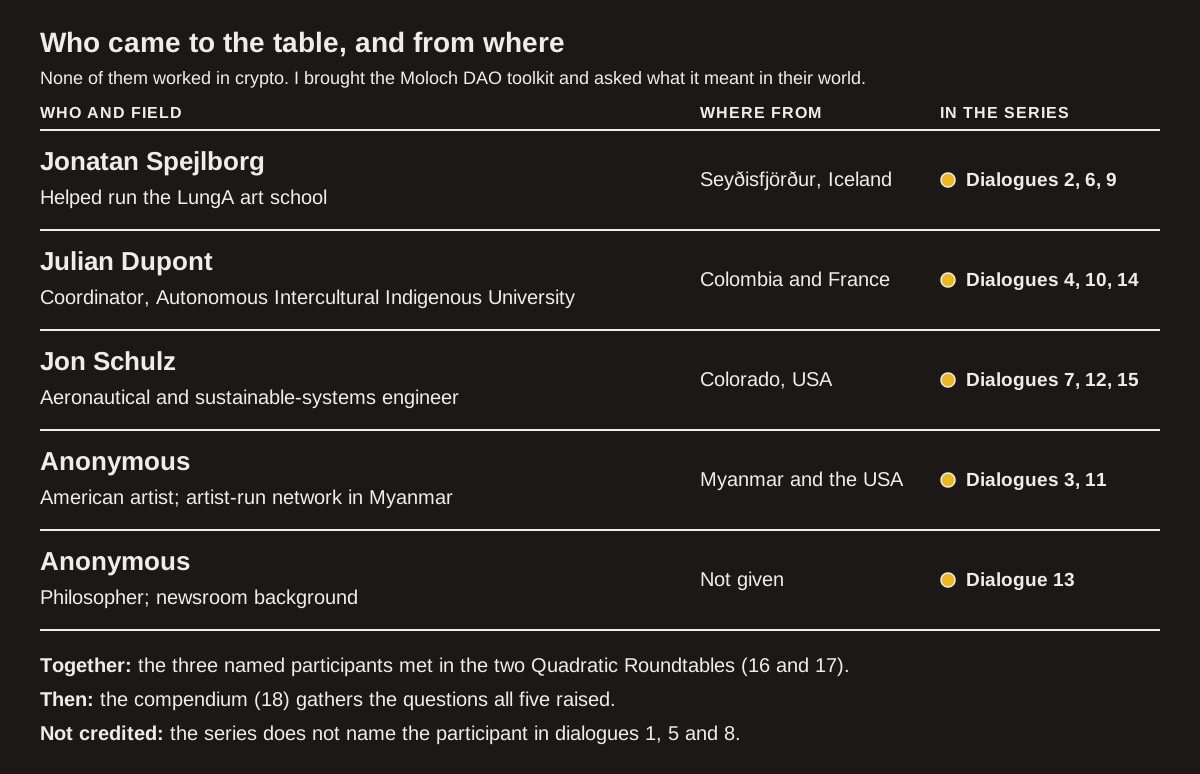
They were not hostile to the subject and they were not converts. Jon Schulz said it plainly in the seventh dialogue: "I am absolutely no expert. I am very wet behind the ears with these concepts." The first roundtable states it as a method: the project had "intentionally excluded insider perspectives" so that nobody would advocate for the community before we understood it, and "we are all outsiders to that community." One participant, a philosopher, put the other side of it: "I really hate tech culture", and also "I'm completely enmeshed" in its tools and values.
Making the Tools Speakable
I did not explain crypto to them. I took one working idea at a time and put it to them as a question about their own lives, and let them say what it was about.
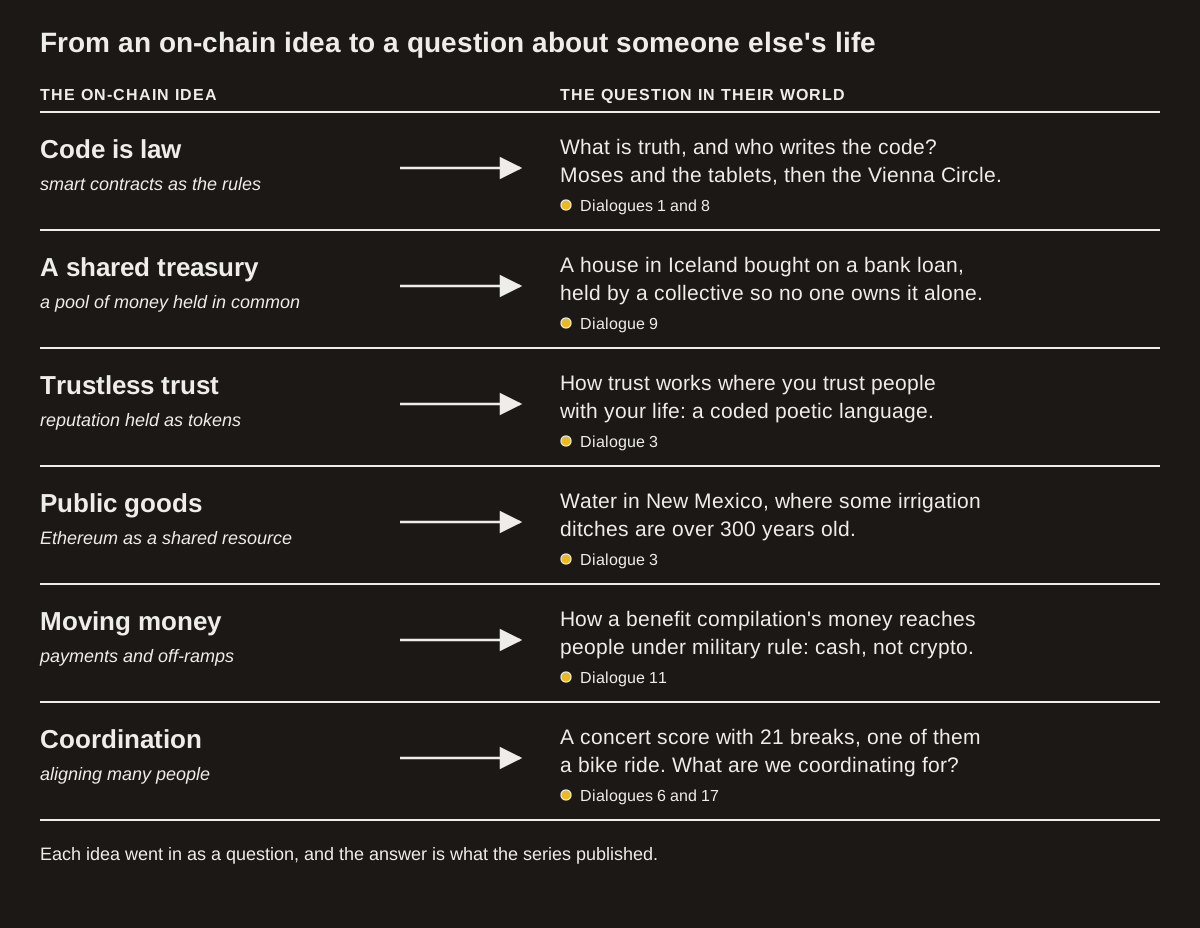
The answers came back in four forms, and I kept all four. Some people reframed the word: when I compared crypto's trust to the dollar's "In God we trust", Julian Dupont turned it into a question about economies "untethered from virtuality". Some tested the idea against a hard case, as the Myanmar conversation below does. Some read it through their own field: Jon Schulz, a systems engineer, saw the energy and heat of mining and warned that "monocultures and monopolies" violate ecological law. And some criticized the culture itself. One participant read the DAO manifestos I shared and found "a lot of cliches and stock phrases"; in the eighth dialogue the question became "Who is writing the code? If code is law, what bias is carried through the code?"
Dialogues, not interviews
Semi-structured interviews would have carried my assumptions into the questions and translated the answers into my vocabulary. I chose conversations of several hours that followed whatever emerged, because I needed methods slow enough for different ways of knowing to become visible before anyone translated them. I published them with minimal editing, stammers and contradictions included, so readers could see how the understanding was built.
One Conversation Up Close: Myanmar
The third dialogue was with an American artist who works with an artist-run, decentralized network in Myanmar. I opened with the grant's language and said "management" might not be the right word for what we were about to discuss. The conversation went somewhere else.
She described artist circles where, in her words, "If you did trust somebody, you trusted them with your life." Under a military regime, organizers had built a coded poetic language: discussions and plans in the open meant nothing to anyone listening in. I told her I had never considered poetics as a form of encryption "so literally". She described blackouts used as psychological warfare, and the day the government replaced the currency overnight, when people who kept their savings in cash "woke up one day to discover that they had absolutely nothing."
Both stories were about problems DAOs said they were solving, seen from the side of people who never had a bank account. The coded poetry was privacy made of language. The currency change was the failure that crypto promised to prevent. So I put the community's own pitch to her: Ethereum as a public good, a parallel economy that could put the means of production back in people's hands. She was curious and sceptical. Someone would need their basic needs met by other means before they could take part at all. Then she asked the question that stayed with me:
Where's the reciprocity? How does a virtual economy purporting to exist outside or parallel to the current economic infrastructure reciprocate with the local needs of the community we have been discussing?
We ended with a request for a volunteer: someone technical who would help us work out how crypto could reach the people being shut out. Two months later, in the eleventh dialogue, I returned to it with a benefit music compilation made to fund people resisting the military. I thought it was a perfect case for a radical use of crypto. She disagreed, and she was right about her case: "I can't make the conceptual bridge between cryptocurrency and oxygen tanks." The money moved by PayPal, foreign accounts and local cash, because "nobody has bank accounts", and what held it together was what she called "embodied trust". I published that too. A tool built for people like her has to start from how trust already works for them.
The Arc of the Series
The series was not planned as an argument, but it became one.
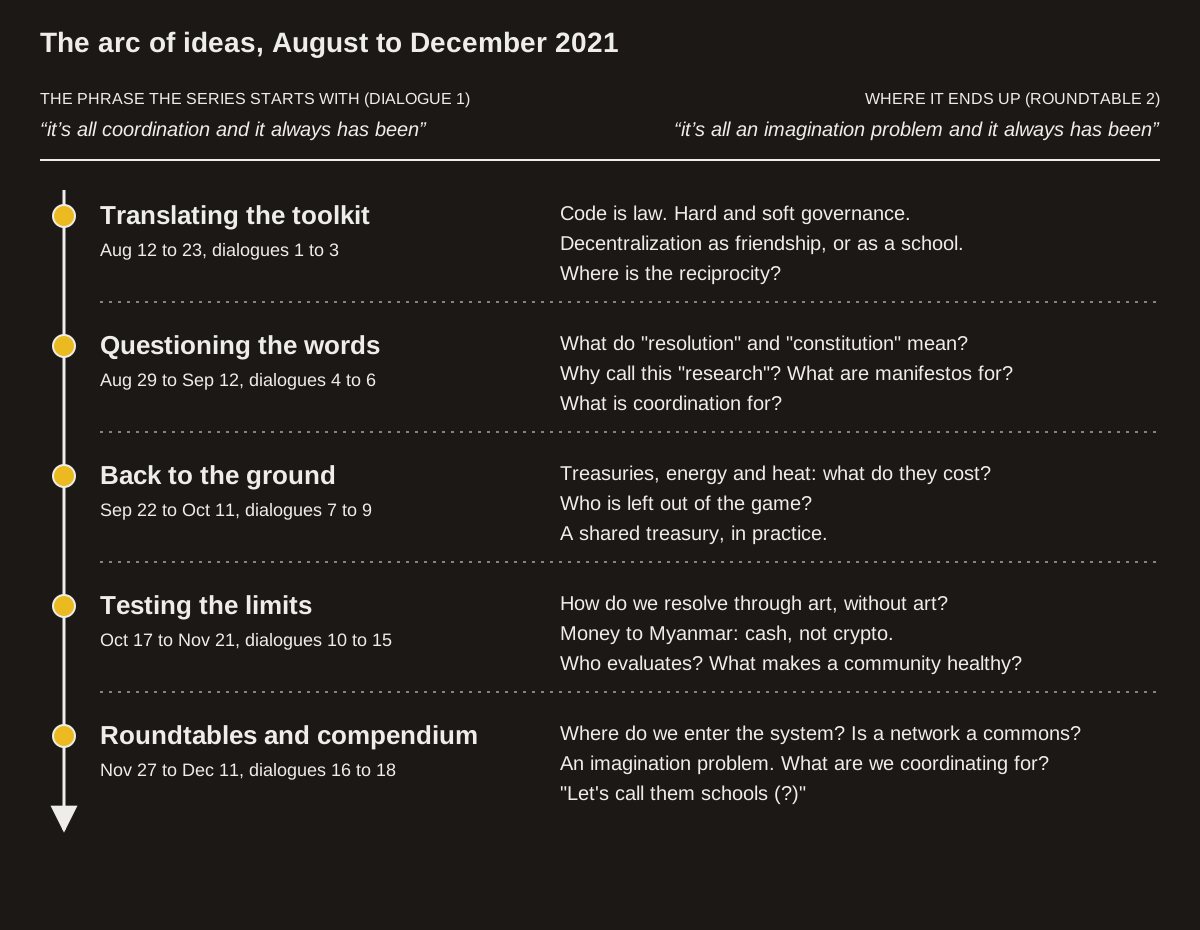
It started with the toolkit: code as law, tokens, treasuries. By the fifth dialogue the question was why we call this "research" at all, and by the sixth the question was whether coordination was worth having without a purpose. In the middle came the groundings, such as a house in Seyðisfjörður in Iceland that four friends bought on a bank loan and a collective carried so that no individual owned it, or an engineer's six ecological laws. By the roundtables, the community's mantra, "it's all coordination and it always has been", had become "it's all an imagination problem and it always has been". The question the second roundtable put at the center was what we are coordinating for.
The tone stayed rigorous. People brought Arendt on the stateless to a DAO manifesto that promised "no passports", Wittgenstein and the Vienna Circle to "code is law", Ostrom's rules to the claim that a crypto network is a commons, and Mauss and Kimmerer to a treasury. Participants pressed one another on what "efficiency" even means. The first roundtable set one goal: "to design better questions."
What the Dialogues Showed
- Coordination fails in language first. Communities with shared vocabulary but not shared meaning believe they agree when they don't. The series reached for equivocity, a term borrowed from anthropology (Viveiros de Castro, Kohn): acting together across real differences without first requiring shared definitions.
- We coordinate as we can imagine. When crypto governance reproduces representative democracy as token voting, or the bank as DeFi, the limit is imagination, not technology.
- Every abstraction loses something. Turning land into a treasury or a relationship into a contract loses what it abstracts, and "trustless" systems still ask for trust in whoever wrote the code.
Two practical ideas came out of the conversations. They are proposals, not tested ones.
Coordination built on reciprocity. From the Myanmar conversation: judge a treasury by what it gives back to the people and places its decisions touch, as well as by what it earns.
Schools, not solutions. In the ninth dialogue, Jonatan Spejlborg described a school-like space in Seyðisfjörður that the town came into. The roundtable asked how a DAO could do something similar: treat part of its work as a school, a protected, semi-sustained space for widening what members can imagine, rather than treating every coordination problem as a bug to fix. The series ends there, on "Let's call them schools (?)", with a question mark.
What It Led To
The grant asked for three reports. It got far more: fifteen conversations that each stand alone, two roundtables in which the participants responded to one another, and a compendium of the questions the series raised, arranged so a reader can enter from any point. All of it is public. It also made room, inside a crypto organization's own grant, for the philosophical questions of the space to be asked by people who did not take its vocabulary for granted. In February 2022 I proposed a second phase that would make that deliberate, a slow way for non-technical communities to enter the ecosystem.
What the grant bought was a different kind of research inside a crypto organization, the beginnings of a shared language across worlds, and the idea I have built on since.
Reflection
The central insight still holds: coordination often fails in language before it fails in systems. We cannot coordinate well around concepts we haven't clarified, and we cannot solve problems that come from the limits of our imagination by optimizing inside those limits.
The series did not solve coordination failure and was not meant to. The questions it generated mattered more than any answers it could have offered, and in a field crowded with solutions to misunderstood problems, finding the right questions was the useful work.
Read the Dialogues
The full series is on my blog. The Myanmar conversation is dialogue 3, and the compendium gathers the questions from all of it.
- Death Dialogues #1
- Death Dialogues #2
- Death Dialogues #3
- Death Dialogues #4
- Death Dialogues #5
- Death Dialogues #6
- Death Dialogues #7
- Death Dialogues #8
- Death Dialogues #9
- Death Dialogues #10
- Death Dialogues #11
- Death Dialogues #12
- Death Dialogues #13
- Death Dialogues #14
- Death Dialogues #15
- Death Dialogues #16: Quadratic Roundtable, part 1
- Death Dialogues #17: Quadratic Roundtable, part 2
- Death Dialogues #18: the compendium