daohaus
CREATOR COLLECTOR RECIPROCITY
A five-week research sprint, funded by PublicHaus, into how a DAO of creators and a DAO of collectors could make culture together and share its value. Published as a three-part series, co-written with plor.
5 weeks · Lead Researcher
Overview
In early 2024 I led a five-week research sprint into a practical question: when many people write one piece of work together, how do you keep track of who contributed what, and how do you share what it earns? The setting was DAOhaus, which builds tools for DAOs (online organizations whose members share a treasury and vote on decisions). A fellow contributor, dekanbro, had designed DUCE (Decentralized Universal Comment Emissions), a way to give every small contribution permanent, on-chain attribution, and was building DIN (Decentralized Intelligence Network) on top of it. PublicHaus funded the sprint to ask what these tools could make possible.
I ran it with plor, a fellow core contributor. The result was Creator Collector Reciprocity (CCR): a design for how a DAO of creators and a DAO of collectors could make cultural work together and share its value, instead of creators selling to speculators. We published it as a three-part series in March 2024 and presented it to the DAOhaus and PublicHaus communities on March 18, alongside an early DIN prototype.
CCR was exploratory by design. It mapped the options and the open questions rather than shipping a product. The DIN team drew on it informally and went its own way.
My Role
I framed the research question, designed the five-week plan and wrote the series, which we published as co-authored. plor researched and synthesized with me throughout, sharpening the arguments and finding the gaps. dekanbro's DUCE and DIN were the starting point, and I worked with him on what was technically possible.
The Problem
The question came out of real frustration. In Pluriverse, a community had spent more than a year trying to build a story together and kept hitting the same wall: when many people shape one piece of work, the tools lose track of who contributed what. A shared document records edits but not ideas; a repository records commits but not the conversations behind them.
Around it sat a wider pattern in web3 culture. Creators had to be artist, marketer, community manager and financial architect at once. Collectors were treated as speculators, and projects promised too much, sold hard and collapsed. DAOhaus had the governance tools (shared treasuries, proposals, ragequit) but they were used mostly for investment clubs and protocol governance.
The research question: how could DAOhaus tools, extended with DUCE, let creators and collectors make culture together and share its value, rather than trade it as speculation?
The Method
Five weeks, from funding in early February to the March 18 presentation, so the work was synthesis rather than fieldwork:
- Reading what existed: dekanbro's DUCE and DIN documents, the Pluriverse experiments, DAOhaus's governance tools, and older models such as open-source contribution, art patronage and publishing DAOs.
- Surveying tools across the whole path from note to published work: knowledge graphs, writing tools, on-chain licensing and minting platforms.
- Comparing mechanisms for how value could move between creators and collectors, and writing down, for each, the questions only a real test could answer.
Each part of the series ends with its open questions, deliberately. The aim was to give the people building DIN a map of the decisions ahead, not a finished answer.
What We Designed: The CCR Stack
The series lays out CCR as a stack of seven layers. The first four are how a Creator DAO makes something together; the last three are how that work meets its collectors and the public. Each layer had its own small drawing in Part One; here they are redrawn as one stack.
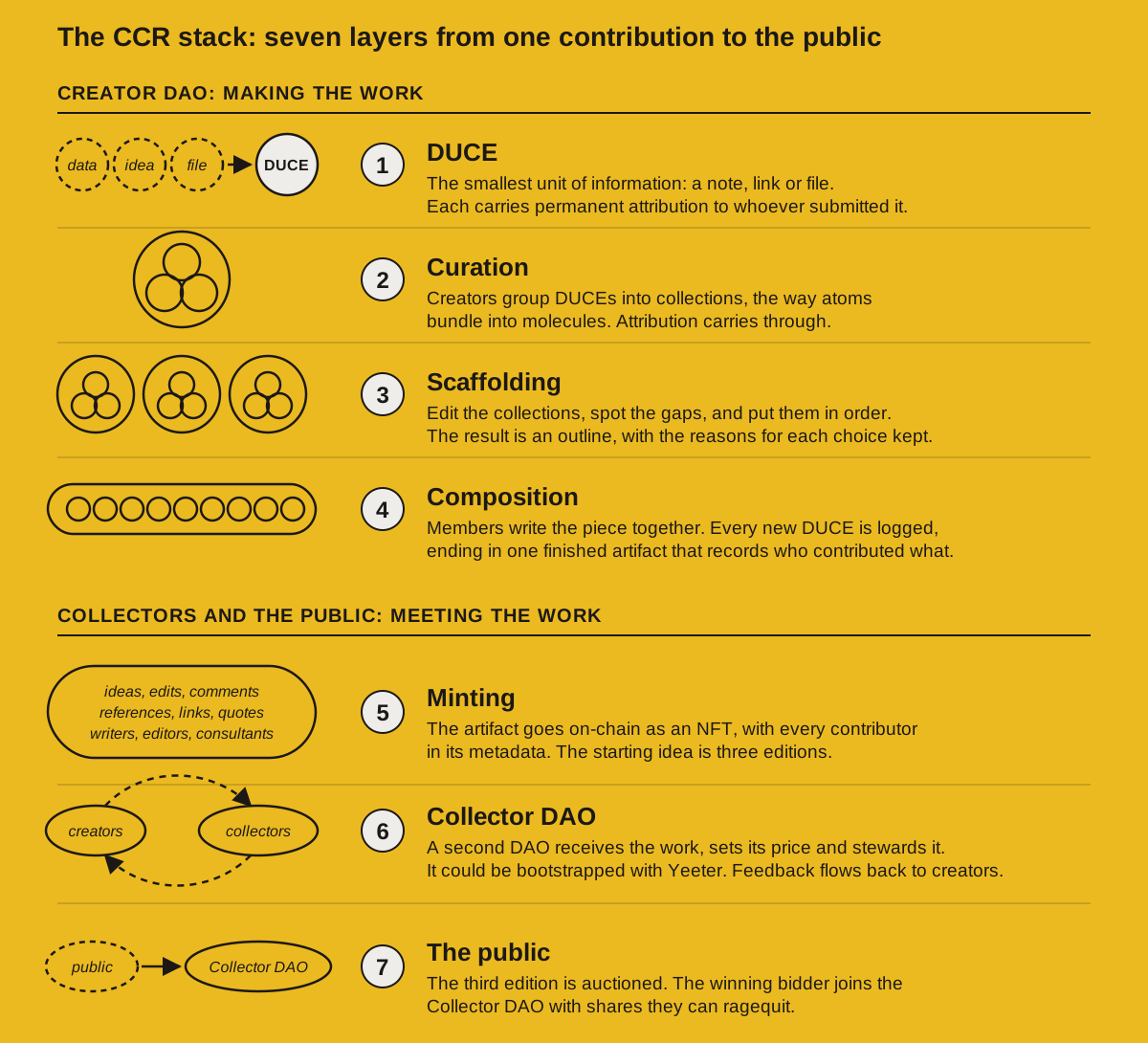
Two DAOs instead of one marketplace. A Creator DAO makes the work; a Collector DAO, which could be funded through Yeeter, supports it, prices it and carries it to the public. The two are meant to keep feeding each other: collectors bring capital, feedback and reach, and creators bring new work.
Contribution to composition (layers 1–4). Members drop small contributions, the DUCEs, into a shared repository, each with permanent attribution. They group them into collections, edit and order those into an outline, and write the final piece together. Every step keeps a record of who contributed what.
Layers five to seven are where the money moves, and Part Two of the series maps the whole flow in one picture: where each edition goes, who signs for it, and who gets paid.
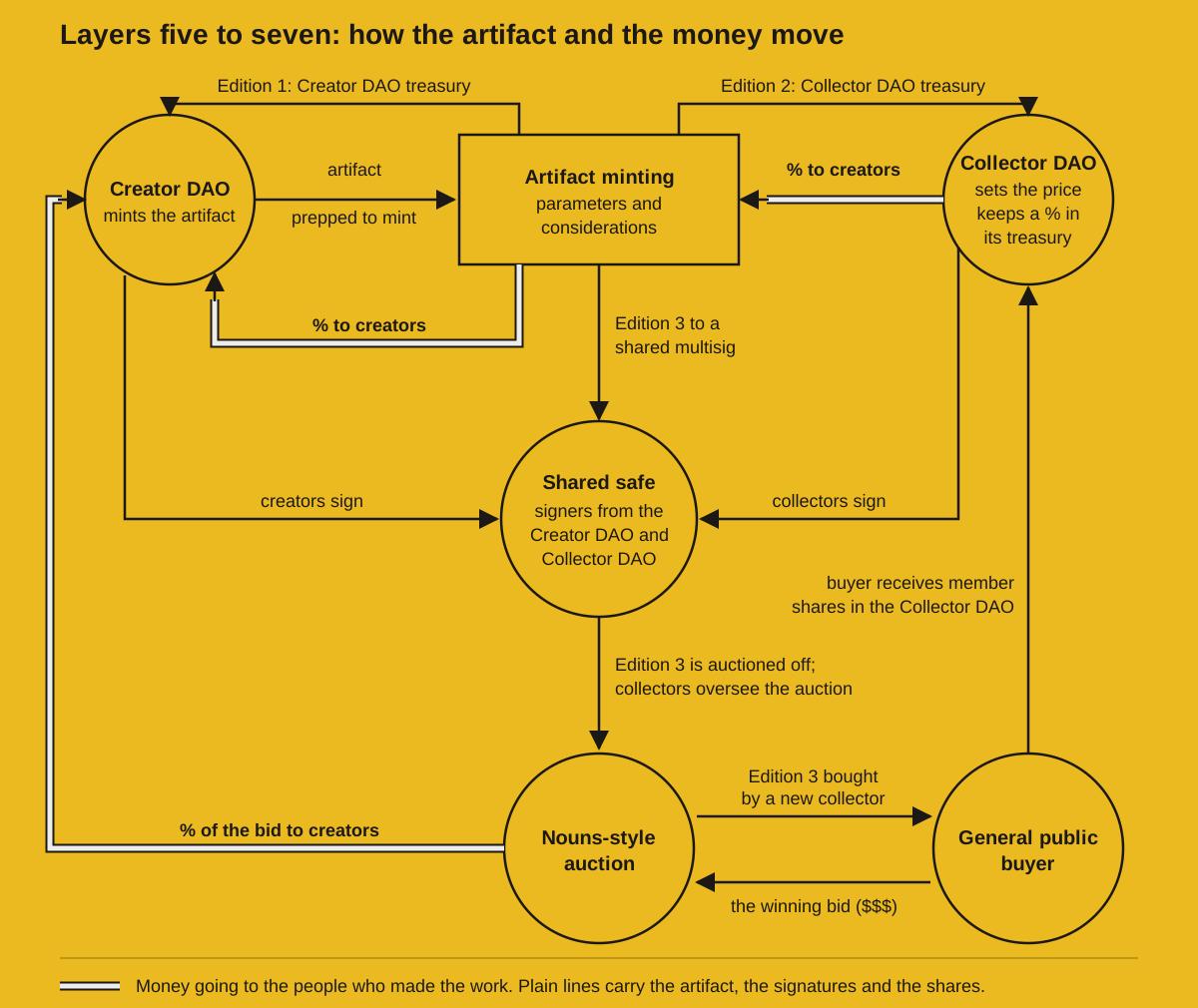
One Mechanism Up Close: One Artifact, Three Editions
The core of the money side is a deliberately unusual mint. When the Creator DAO finishes a piece, it mints three editions, and each goes somewhere different. Part Two of the series works it through with numbers:
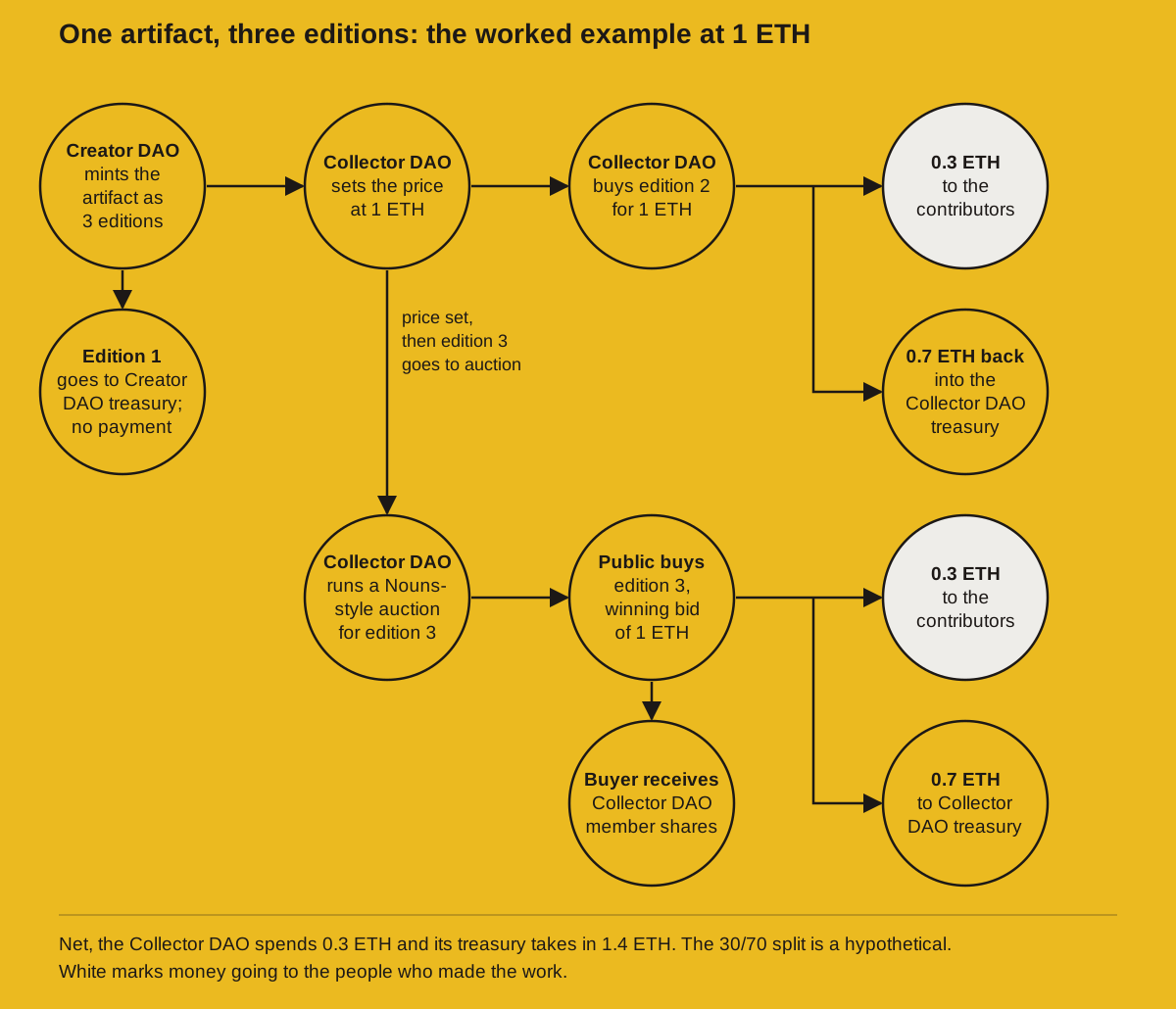
- Edition one goes to the Creator DAO's treasury: proof of creation, with no money changing hands.
- Edition two goes to the Collector DAO at a price the collectors set. At 1 ETH, 0.3 ETH goes straight to the contributors and 0.7 ETH returns to the Collector DAO's own treasury.
- Edition three is auctioned to the public from a safe both DAOs sign. At 1 ETH, the contributors again receive 0.3 ETH and the Collector DAO 0.7 ETH, and the buyer receives shares in the Collector DAO, a position they can ragequit.
The design puts the collectors in a tension on purpose. They set the price, so they want it high enough to make the work valuable in their treasury and low enough that the public keeps buying and joining. The supply of each work, and the pace at which new members arrive, become decisions the two communities make together: we called it a culturally regulated bonding curve. Part Two also names the weak point: the model depends on new buyers continuing to arrive, and whether that growth could be sustained is something only a live test could show.
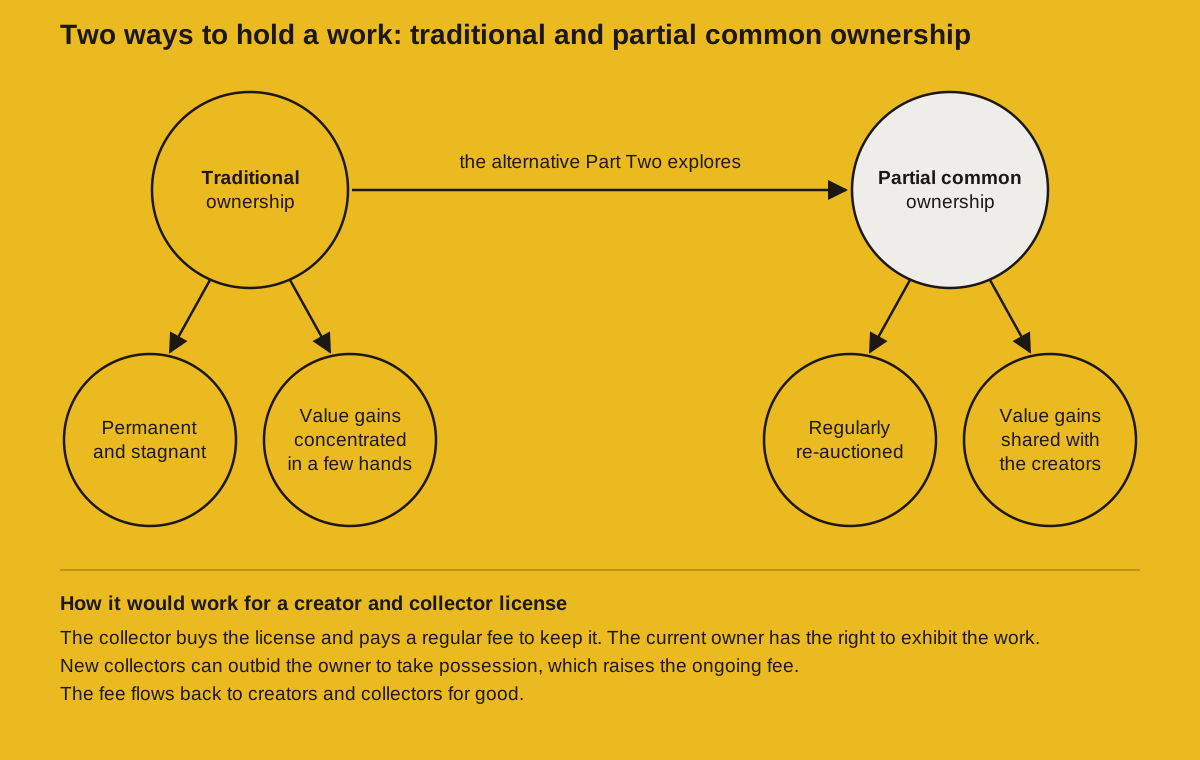
Part Two set this beside other ways of sharing value, each with different behaviour: Harberger taxes, in which collectors declare a price, pay a fee on it and must sell at it; partial common ownership through time-limited licences; licences that slowly return rights to the creators; and on-chain licensing that separates the right to show a work from owning it. None was declared the answer. The point was to make the trade-offs comparable.
The clearest contrast is partial common ownership against the ordinary kind, where a collector holds a work for good:
What It Led To
- The three-part series, published in March 2024 and presented to the DAOhaus and PublicHaus communities on March 18, alongside dekanbro's early DIN prototype.
- An informal influence on DIN. The DIN team drew on the research and made different choices: public-first instead of closed creator and collector loops, one DAO per topic instead of two, and simpler contributions instead of layered curation.
Their choices simplified the structure and lowered the bar for taking part, trade-offs I hadn't fully weighed; how they played out in practice is beyond what this research can show. Public-first probably suits information that wants wide reach; the reciprocal loop suits cultural work that needs long stewardship.
What I Learned
Synthesis is real work. Most of the value was in connecting experiments that already existed (Pluriverse, DUCE, the knowledge-graph work in the community) into one picture with a shared vocabulary.
Theory underestimates the details. Questions that looked simple in the research, such as whether tags live inside a contribution or outside it, turned out to hide hard technical trade-offs. Mechanisms that looked elegant on paper, such as Harberger taxes, bring psychological effects you only see in use.
Five weeks maps the territory; it doesn't settle it. The series ends with more questions than answers, and that was the right outcome for the time we had.
Read the Series
Part One: layers one to four of the CCR stack · Part Two: layers five to seven · Part Three: what reciprocity means