supermodular
PLURIVERSE
A world I founded and built with a community through lore, art, music and ritual, and the four organisations I designed to govern it. Incubated by Supermodular.
18 months · Founder, Creative Director & Governance Architect
Overview
Pluriverse was a fictional world written in public. I founded it in 2022 as a transmedia project (comics, a book, music, art, essays, games) in which a community would write the lore of a shared future instead of receiving it from one author. Supermodular, the venture studio, funded and incubated it. Over eighteen months I set its creative direction, ran its community and designed the organisations that were meant to govern it.
It left behind a published book, a concept album, commissioned artworks, a guide and its documentation. The four-organisation federation I designed to govern the world was never deployed. What did run was the community itself: weekly calls, off-chain votes, on-chain payments for the NFT sales, and a process for ratifying lore. This study starts with the world, then shows how it was meant to govern itself, and keeps the two apart.
My Role
I founded the project, art-directed its commissions, ran the community calls and the lore process, and designed its governance. The Guide was a joint work, credited to three of us. The music was made by the band Essential Fictions, the album's collage artwork by Billy Sprague, and the comic pages by illustrators I briefed.
The World
The idea came from my comics for Gitcoin, which I wrote through Raid Guild (see Coordination Comics). A story that was meant to belong to a community still had a single author. So we began writing the world down as a guide that others could add to, then hand it over.
The project's own definition of its name was short: "a world consisting of many worlds", after Arturo Escobar's Designs for the Pluriverse. Our stated purpose was to build cultural momentum around a more pluralistic world, and to draw attention away from the single, centralised metaverse. The Guide put the theory in one line: "Storytelling is the technology of imagination." The community's manifesto, which I drafted, put the politics in another: "Our lore is our law; our code is our bond."
The world itself is the Quadratic Lands, a near-future Earth run as one vast cooperative machine, with a life-support grid tended by AI shamans. Its people are the Anons, outsiders who split into two camps. Solarpunk Anons form DAOs and practise regenerative economics. Lunarpunk Anons build privacy tools and eventually go dark. Around them sit other factions: BUIDLRs, who are building an ark to the quadratic lands; the in-gamers, who speed-run futures in simulation; and an ascetic crew who break things on purpose to find the bugs in us.
The villain is Moloch, god of coordination failure, and the Guide insists he lives inside us: "Moloch lives within us." It sets out a taxonomy of Molochs, from the cosmic to the numinous. The hope is the Green Pill, "a symbolic pledge of the hopeful to continue being hopeful." A party of Raid Guild adventurers, each standing for a community in the Ethereum ecosystem, shares the map with adjacent planets, each with its own rule and its own artifact: a planet-sized marketplace, a world of permanent dusk, a tavern that serves cinnamon buns.
How the World Was Made
Writing. The Guide is the lore bible and the rulebook in one book. Around it I wrote the manifesto, an article series on the art history of revolt (Dada, Situationism, Fluxus, punk) to show where solarpunk and lunarpunk came from, and short stories for future graphic novels. In one, a woman strapped into a metaverse apparatus relives her own family's inherited trauma. In another, workers in a coal-mine city slip away to build a machine, then split into factions whose jargon drifts so far apart that they stop understanding one another.
Art. I wrote the art direction for illustrators and sent it with video references and a lot of freedom. One brief made ETH Bot, the world's champion against Moloch, a weapon rather than a person: five robots, each standing for a layer of the web3 stack, fitting together like a blueprint to do what none could alone. Another was a cross-section of the future city, from a molten core to a cloud lattice. The commissioned artworks that came out of this set the world's look, from solarpunk optimism to lunarpunk critique.
Music. The album Ambiguities for Discontinuities by Essential Fictions answers Escobar's book and the questions of the moment: autonomy, anonymity, privacy, sovereignty. I conceived and produced it, set the themes and gave the band full creative freedom within them. For two months I explained the Ethereum community to the artists one to one, so they could interpret it in their own way. In the grant proposal that paid for it, I committed all funds to artists and production and none to operations.
Ritual. The mechanisms were written as rites. I wrote briefs for the images of two circles. The Lorecrafters Circle was an entrainment of attention, closer to the "matrix songs" of Le Guin's Always Coming Home: fleeting, collaborative, something that "defies being written." The Bloodletters Circle was an image of sacrifice, built from a vessel, a blade, a scar and an altar. Joining the second was designed as a gift that cost you, not a purchase.
The Community
The community formed in September 2022, around the Guide's launch, in a Discord and a Telegram group. The first call promised to "stay with the trouble" and ask better questions before building anything. After that the weekly calls ran as workshops, each building a shared knowledge graph on a board and recorded, with a weekly digest of every channel, a book club, and a shared documentation space.
I organised the work as two hemispheres. The right was divergence: product and lorecraft, where the lorecrafters were left "diverging wildly on creative ideas" with no pressure to condense. The left was convergence: economics and legal. The centre held community and organisational design. Members brought their own threads. One member proposed to "reclaim god from the god ponzi" and got his own Scarlet Monastery channel to play the idea out. The "secular morality" that grew in that channel later became source material for a stablecoin team's one-page comic for ETHDenver, in which new gods are made of math.
I also put the community's questions into the open, in writing. Who are we? How are contributions recognised as canon? How do we encourage a critical culture while empowering makers? Many were still open when the project ended. They were the agenda.
One Idea Up Close: A Novel Becomes a Structure
The book club's main text was Ursula K. Le Guin's Always Coming Home, an archive of a future people told through songs, stories, maps and a guide to their world. It changed how I designed the community.
In October 2022 the Discord was filling up and I was worried about information overload for new members. My notes for that week's call took from the book a "world stage": an audience, a front stage, a hinge or portal, and a back stage. I proposed turning it into Discord roles "to control information overload," so a newcomer meets the story first and the machinery later, and is drawn inward one step at a time. I took a second thing from the book: its range of narrative forms, from jokes and children's games to cautionary tales, hearth stories and songs that defy writing. I proposed matching each lorecraft form to a layer of the structure.
The same logic organised the work. I split it into three tiers. The outer tier was the loss leaders, the comics and books that draw people in. The inner tier was the design studio. Between them sat the article series, "the hinge between worlds," the portal for people moving from the soft outer layers to the harder core. "Each tier informs the other." The idea that carried through was the shape of the four organisations, shown below.
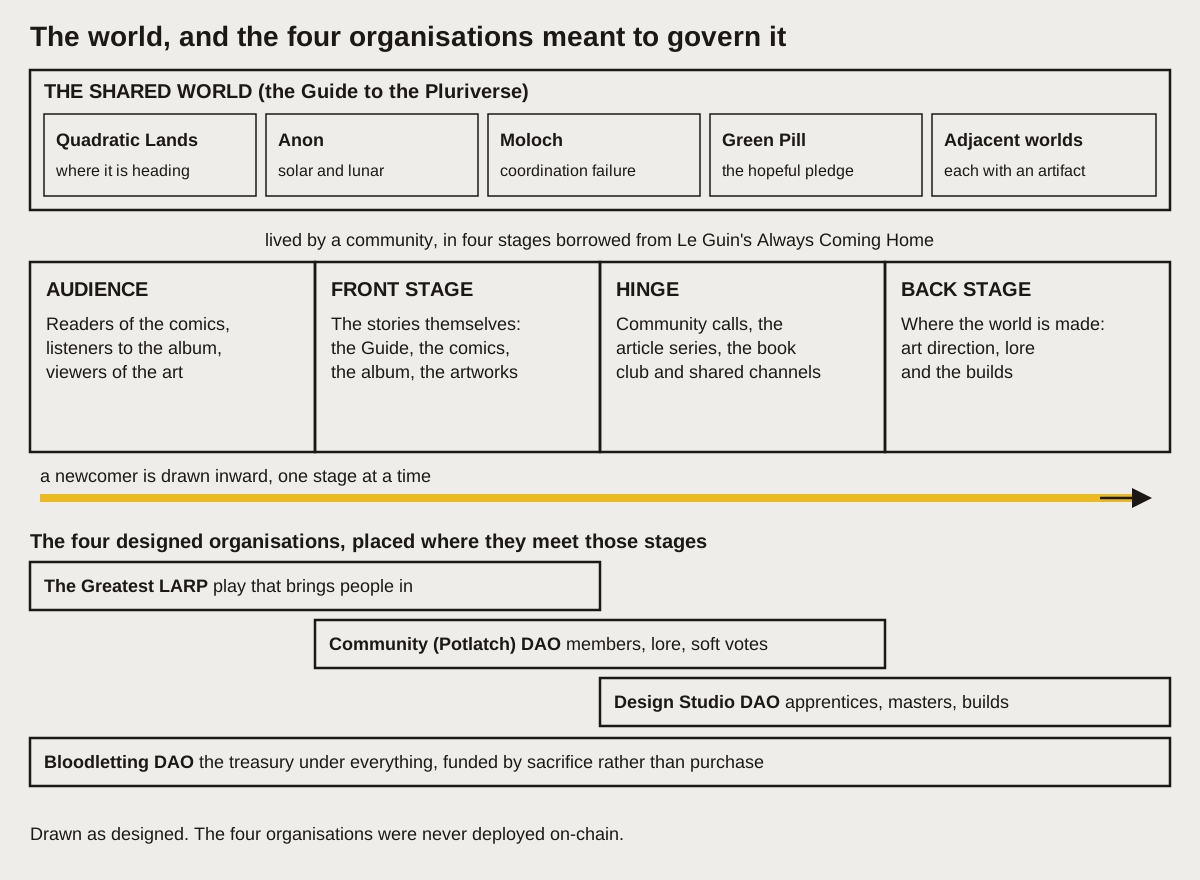
How the World Governed Itself
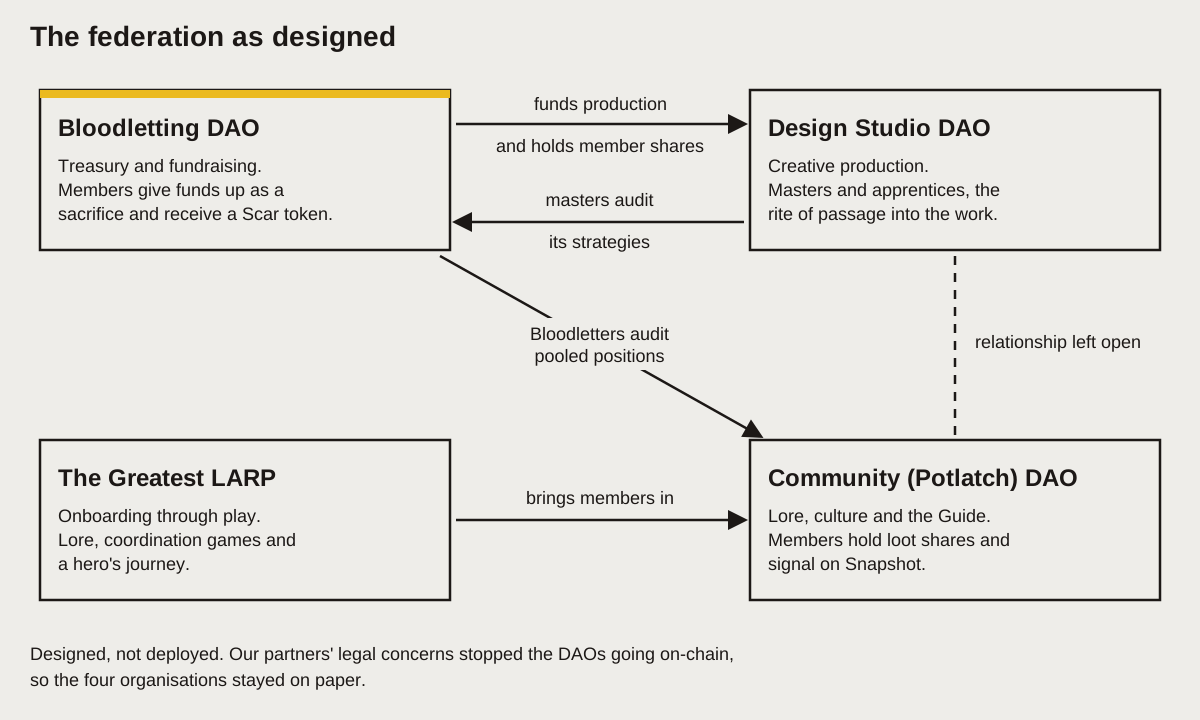
The first design was a single Pluriverse DAO, set out in the Guide. Anyone could submit lore. Contributors paid a small symbolic tribute to join and held loot shares. In October 2022 I split the work into three ritual circles with their own treasuries: Potlatch for the community, Rite of Passage for the studio, Bloodletting for money. The Greatest LARP, which began as a comic's launch game, was redesigned as the way in. That made four organisations, all to run on Moloch v3 contracts.
| Organisation | Ritual | What it governed |
|---|---|---|
| Community (Potlatch) DAO | A gift | Lore, culture and the Guide. Members joined with a pledge of part of their income. The token was built to be given on, and those who passed it on earned a status token. |
| Design Studio DAO | A rite of passage | Creative production and keeping the canon. Apprentices became masters when a master staked their own funds on them. |
| Bloodletting DAO | A sacrifice | The treasury. Members gave funds up and received a non-transferable Scar token that earned a vote on how the treasury was invested. The strategies were named for animals: a paranoid bear, a comfy crab, a YOLO bull. |
| The Greatest LARP | A game | Onboarding through lore, coordination games and a hero's journey. |
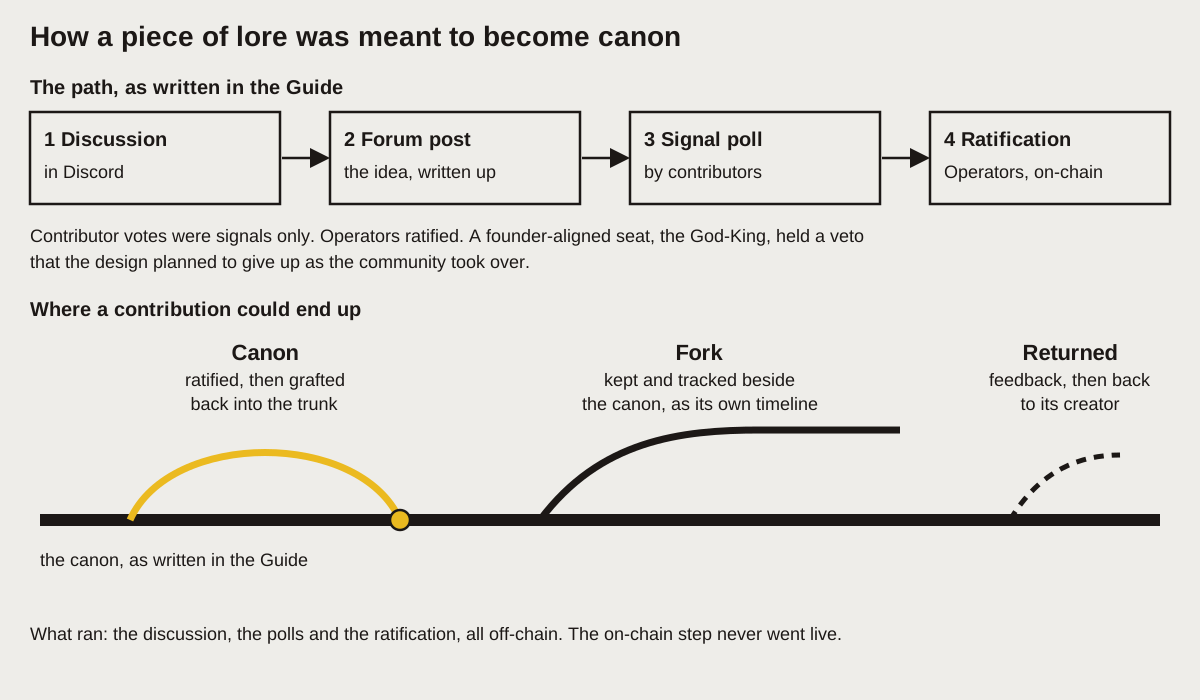
How lore was meant to become canon. I called the structure dendritic lore: the canon is a trunk, and new projects spin off it like dendrites. A contribution moved from a Discord discussion to a forum post to a signal poll by contributors, and from there to an on-chain proposal. Contributor votes were signals only. Operators ratified. A founder-aligned seat, the God-King, held a veto that the design planned to give up as the community took over. A contribution could be ratified and grafted into the canon, kept as a fork so the community could follow the divergent timeline, or returned to its creator with feedback after a quality check.
The design had one weak point, and I named it early. Every proposal had to name an audience, a problem and a value, involve more than one person, name a point person and say how it would report. Someone had to hold proposals to that bar, and in practice that was me. A single curator could not scale with the community, so the plan was to hand curation to a pool of peers over time. Until then, I did the filtering.
What Ran, and What Stayed on Paper
What ran. The community calls. Off-chain votes, in Discord or on Snapshot. On-chain payments for the NFT sales. The lore ratification process. A revised second edition of the Guide, published on schedule.
What stayed on paper. The four organisations, their treasuries and the Potlatch and Bloodletting mechanisms, the apprenticeship stake, the Greatest LARP rebuild, and the plan to hand the world over in stages. Our partners' legal concerns about token distribution stopped them going on-chain. A crowdfunding campaign for the Guide's launch had been set up and could not be tied to the project. The lesson I took is that a governance design has to account for the legal ground it will stand on, not just the code.
What It Produced
- A published book.
- Ambiguities for Discontinuities, a concept album by Essential Fictions, pressed on vinyl, with artwork by Billy Sprague.
- Commissioned artworks that set the world's look, printed and shown at a side event at ETHDenver.
- The Guide to the Pluriverse, the living reference, with a revised second edition.
- Documentation: the manifesto, the article series, call notes, and diagrams of the structures above.
What Didn't Work
The Guide shipped with no way in. Its launch described a crowdfunding and contribution route that legal concerns had pulled by the day it went out. We handed out a book about a world whose door was closed.
It asked too much of people. In my own post-mortem the cause was plain: too much complexity, too much freedom and not enough structure. Contributors did not ask for freedom. They asked for permission, for tasks and for summaries. Even the people closest to the work could not get past the surface of the Guide in the time they had.
It slid into a solo effort. I worked in public and kept the calls going, but by the end the channels had gone quiet and I was working mostly alone, so the plan to hand the world over had no one to hand it to.
The release missed its moment. The album was made for ETHDenver, slipped by months, and came out to an audience nobody had built. I also stayed off social media, and assumed others would show up. The academic journal we proposed never got going, and I returned its funds.
The money never held. The work depended on grants and never found a model that paid for itself.
Reflection
A community needs shared stories as much as it needs shared rules, and the order matters: culture first, then decentralisation. A vote handed to a community that does not yet share a story is a mechanism without a reason to use it. Pluriverse also taught me the other half. A culture cannot use freedom until someone has built the door in, and I built the world before the door. I now design the way in first.