gitcoin
COORDINATION COMICS
Five comics for Gitcoin, written and art-directed by me, that turn coordination failure and the mechanisms meant to beat it into stories you can feel. Handed out at ETHDenver and Schelling Point.
2022–2025 · Lead Writer & Art Director
Overview
Gitcoin's Coordination Comics explain the ideas behind Gitcoin's work as stories: coordination failure, which the community calls Moloch, and the funding mechanisms meant to beat it. I took over the series at its third issue, as a Raid Guild engagement for Gitcoin, and wrote and art-directed five issues, #3 to #7, between 2022 and 2025. Horacio Boriotti drew them.
The issues were handed out at ETHDenver and Schelling Point, with Gitcoin's founder Kevin Owocki as a collaborator, and all five are free to read online.
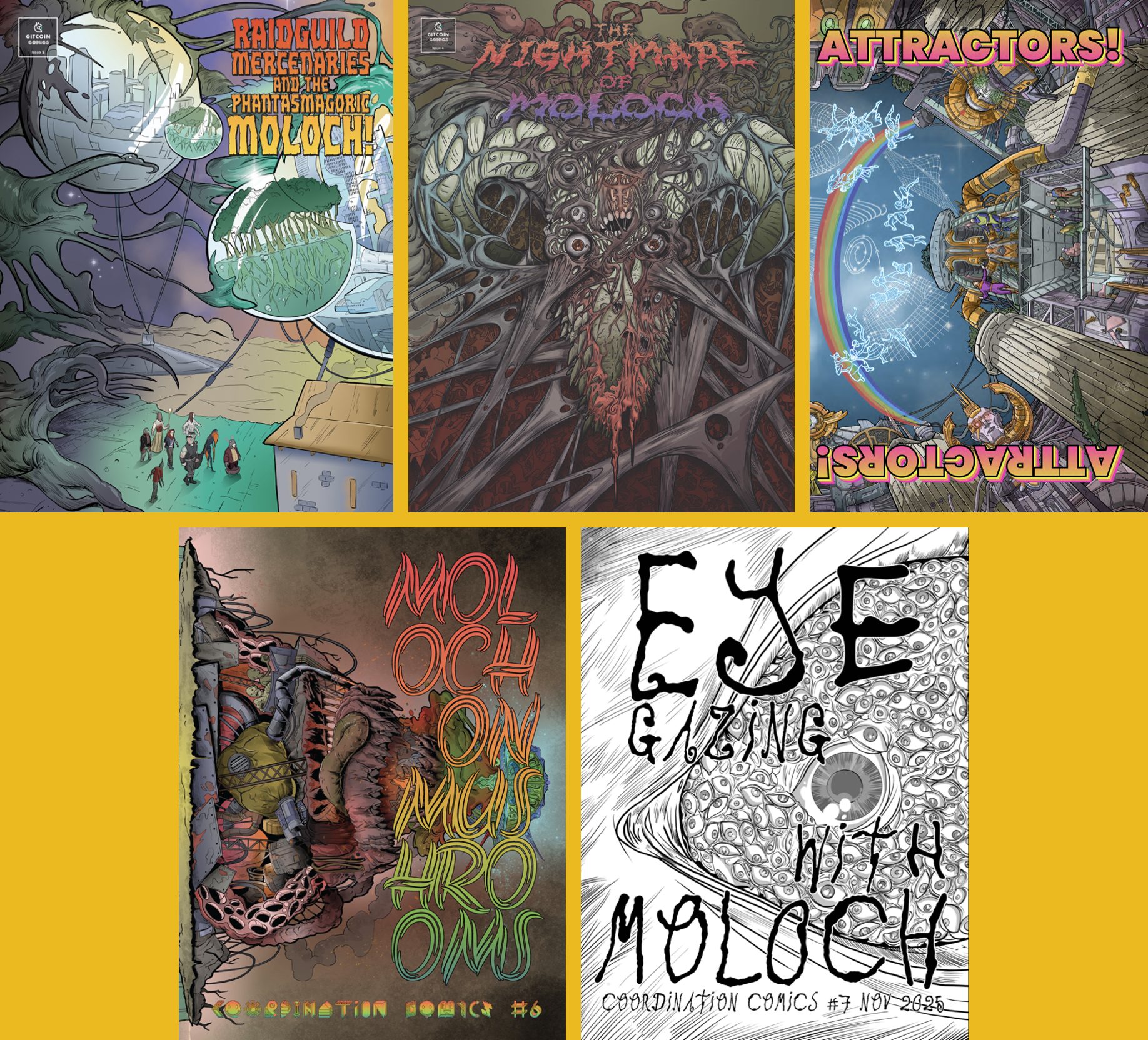
The approach behind all five: don't explain an idea, let the reader live through it.
My Role
I set the concept and direction for each issue, wrote the scripts, and art-directed the artist with reference boards and page-by-page notes. I chose which ideas each issue would carry, did the research behind them, and took each script through rounds of feedback with Gitcoin's team.
It was a small Raid Guild party, and the credits name it. On #4 they read: concept and direction, Travis Wyche; Monk, plor; Cleric, Dao Jones; art, Horacio Boriotti; lettering, Alex De Luca.
The Problem
Gitcoin funds public goods, and its ideas are hard to hold in your head: game theory, quadratic funding, and Moloch, the name the community uses for systems that reward each person for doing what is collectively disastrous.
The comics had to work for three audiences at once: crypto builders, researchers, and curious newcomers. Each issue had to stand alone and still carry the series forward, and each had to make an abstract idea concrete without dumbing it down.
The Method: Translate, Don't Explain
I worked from a simple rule. There are three ways to put an idea into a comic:
- Literal: a character explains it. I avoided this.
- Metaphorical: a surface comparison. Not enough on its own.
- Embodied: the reader experiences the idea through what the characters go through and how the page is built. This is what I aimed for.
| Idea | What the reader experiences instead |
|---|---|
| Moloch's pull | In #3, characters' eyes hollow out as they give in to competition, a sign the reader learns without being told |
| Multipolar traps | In #4, many voices shout at once across pages drawn in colliding styles, until the protagonist can't act |
| Strange attractors | In #5, systems drawn as 3D wireframes the reader can watch settle into stable states |
| Mycelial economics (MycoFi) | In #6, a journey through six shifting art styles, from gothic horror to Art Nouveau networks |
| Protopia and dystopia | In #7, pages that set two futures against each other, so neither is the obvious outcome |
Directing the Art
Most of my direction happened before Horacio drew a line. For each issue I built reference boards that turned an abstract idea into an aesthetic: Art Nouveau typography and mycological plates for #6, sacred geometry and mathematical plots for #5. Each issue also got a colour language tied to its argument. In #3, green means coordination working and dark purples mark Moloch's influence. In #5, holographic blues carry the mathematics and earth tones the physical world. In #6, the palette changes with each stage of the journey. Even the lettering carries meaning: in #6, Moloch speaks in rigid, angular type and the guide in flowing, organic type.
One Issue Up Close: #4, The Nightmare of Moloch
Issue #4 was the riskiest. Instead of explaining multipolar traps, it puts the reader inside one. The protagonist falls into a nightmare where each page is a different domain in which coordination fails: technological determinism, militarism, industry against nature, inequality, security against freedom. Each page mixes art styles and palettes, so the competing worldviews literally collide on the page. In the end the voices turn on the reader: "You are mine. You are me. Our name is Moloch."
The finding came from Gitcoin's own team. Reading the script, leadership worried that the nightmare would leave readers feeling helpless, and that a comic meant to rally people to coordinate would make them give up.
The decision: I added an awakening. The issue no longer ends inside the nightmare. The protagonist wakes, shaken, unsure whether it was a dream or a vision of the future, and asks: "But what can I do? How can I act? What comes next?" Awareness becomes the first step of change, not the end of the story, and #5 answers her with tools.
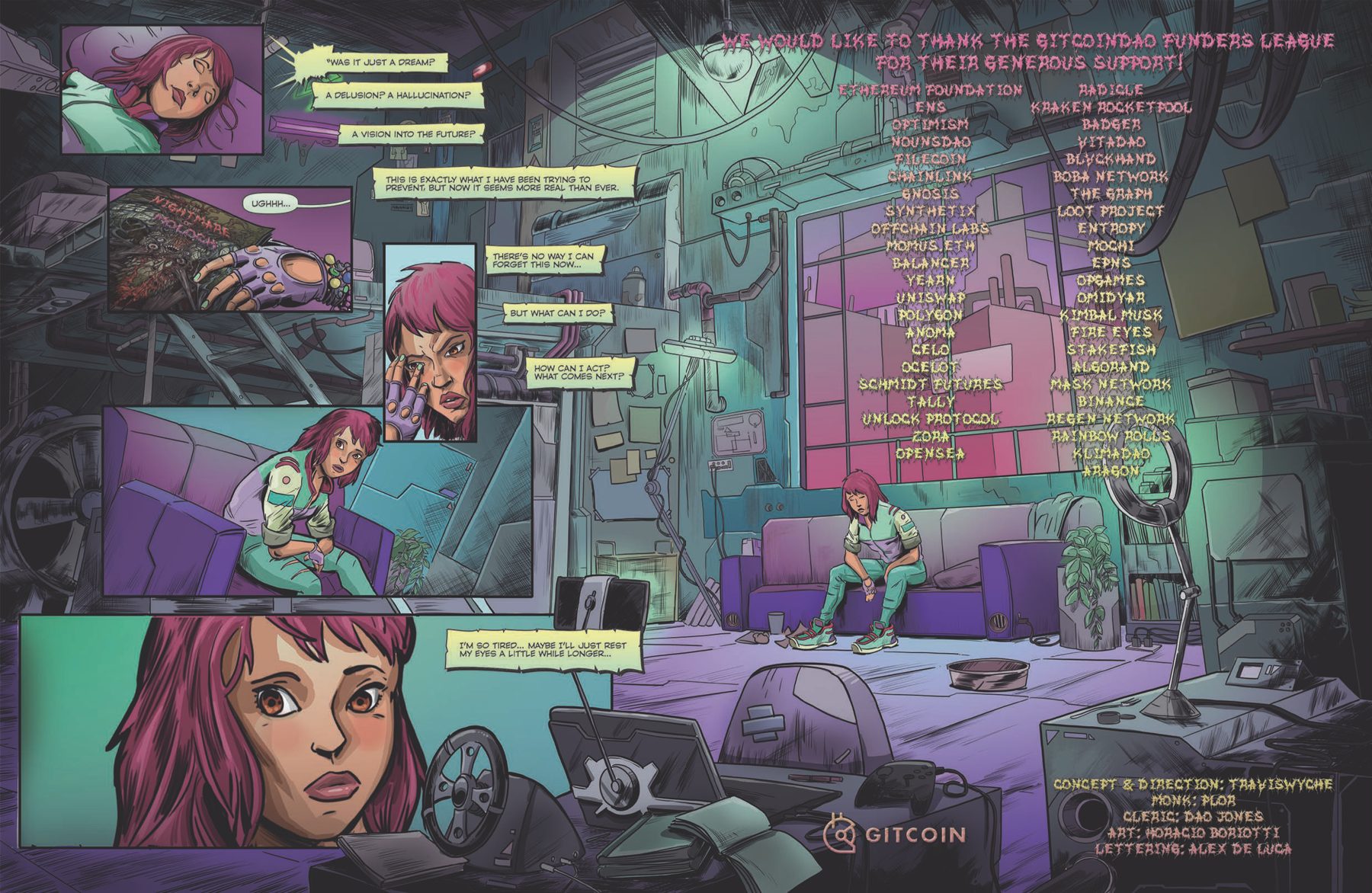
It was a trade-off. The nightmare's force came from leaving the reader with no way out, and the awakening softens that. But it turned the series from a diagnosis into an argument with a next step, which is what Gitcoin needed it to be.
The Series as One Argument
Read in order, the five issues make one case:
- #3, RaidGuild Mercenaries and the Phantasmagoric Moloch! sets out the problem. A party of adventurers is shown a better, cooperative future, understands it, even feels it, and still retreats to competition because competition feels safer. Their eyes hollow out as they give in.
- #4, The Nightmare of Moloch raises the stakes and makes the reader complicit.
- #5, Attractors! Attractors! offers tools. It turns dynamical systems theory into visual form and grounds it in real mechanisms: quadratic funding, retroactive public-goods funding, conviction voting.
- #6, Moloch on Mushrooms asks what it takes to change. It draws on the MycoFi framework and moves through six art styles, as if the reader's perception has to shift before the system can.
- #7, Eye Gazing with Moloch closes on a choice. It runs from the first sparks of coordination failure in early tribes to today's crises, then sets two possible futures side by side.
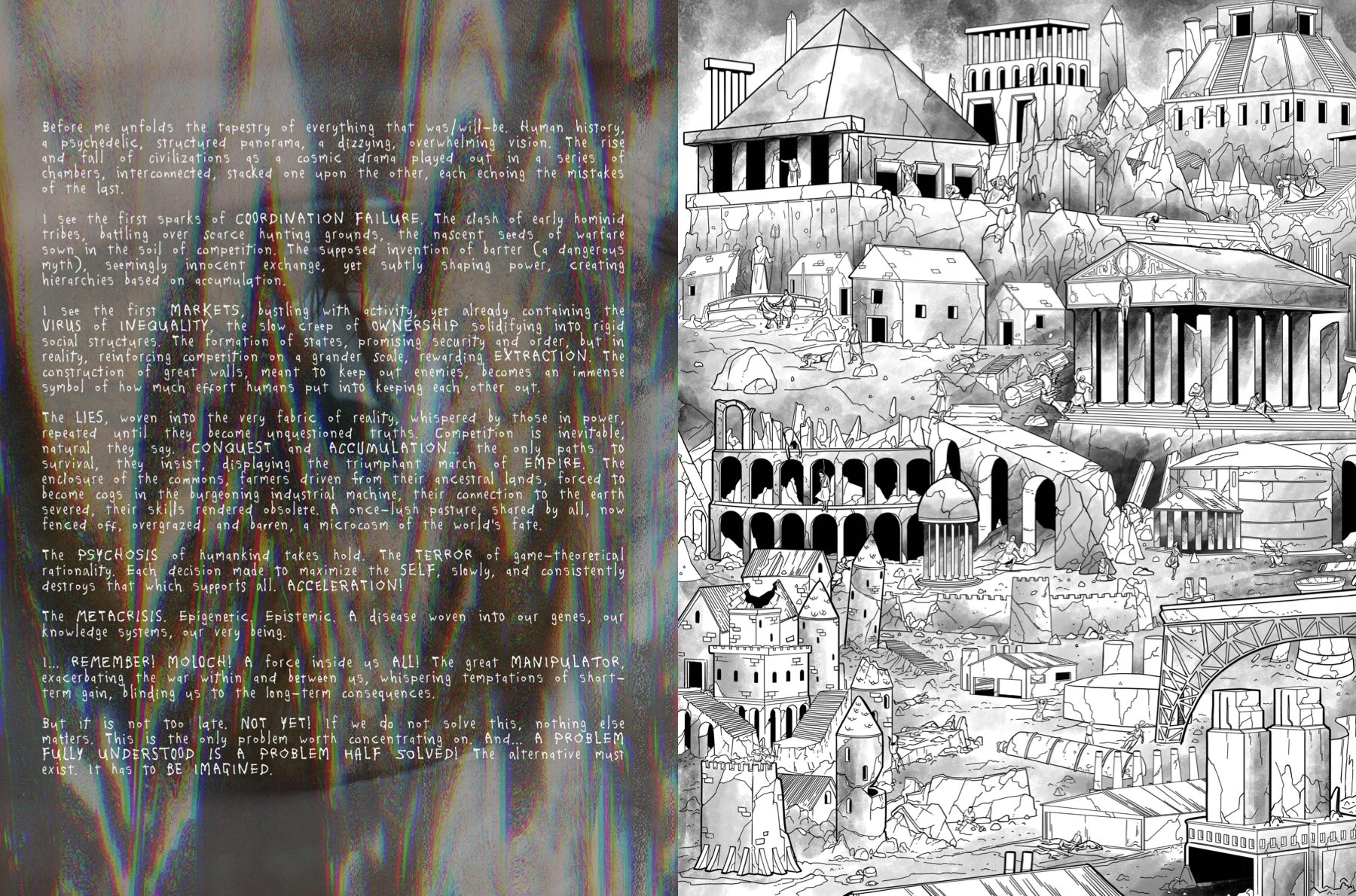
All five issues are free to read as PDFs on greenpill.network: Coordination Comics #3, Coordination Comics #4, Coordination Comics #5, Coordination Comics #6 and Coordination Comics #7.
What It Led To
- Five published issues, handed out at ETHDenver and Schelling Point and free online.
- Pluriverse. Writing #3 is where I saw that collective storytelling needs governance of its own, the question I took into Pluriverse.
I don't have readership numbers for the series, so I won't claim reach beyond where the comics were handed out.
What I Would Do Differently
Bring the tools in sooner. #4's nightmare was powerful, but readers waited a whole issue for a way forward. Showing a tool earlier, even in #3, would have balanced the diagnosis with hope.
Build the characters across issues. The ideas carried the series more than the people did. The mentor relationships in #5 and #6 showed how much a recurring bond adds; I would establish them from the start.
Give newcomers a way in. #6 and #7 were the boldest issues and the hardest for readers new to coordination theory. A short companion guide or discussion prompts would have opened them up without diluting them.