independent
WISCAM
Independent research that builds on my category work for Allo Capital and names a new category, wisdom capital allocation. Fifteen interviews, more than 120 sources, a 40-page paper proposing three mechanisms. The direct antecedent of the Existential Protocol.
2025 · Independent Researcher
Overview
From January to July 2025 I ran an independent research project on a question I kept running into in decentralized communities: when a group's thinking creates value, why does almost none of it flow back to the people who did the thinking?
The result was a 40-page research report, WisCAM (Wisdom Capital Allocation Mechanisms), built on fifteen interviews and more than 120 sources. It argues for a category of value that behaves unlike money: it isn't used up when shared, it multiplies when combined, it depends on context, and it emerges from networks rather than individuals. It then proposes three mechanisms a system would need to credit and reward that value.
WisCAM is a theory, not a product: nothing in it was built or tested as WisCAM. Its outcome is what came next. The report is the direct antecedent of the Existential Protocol.
Where It Comes From
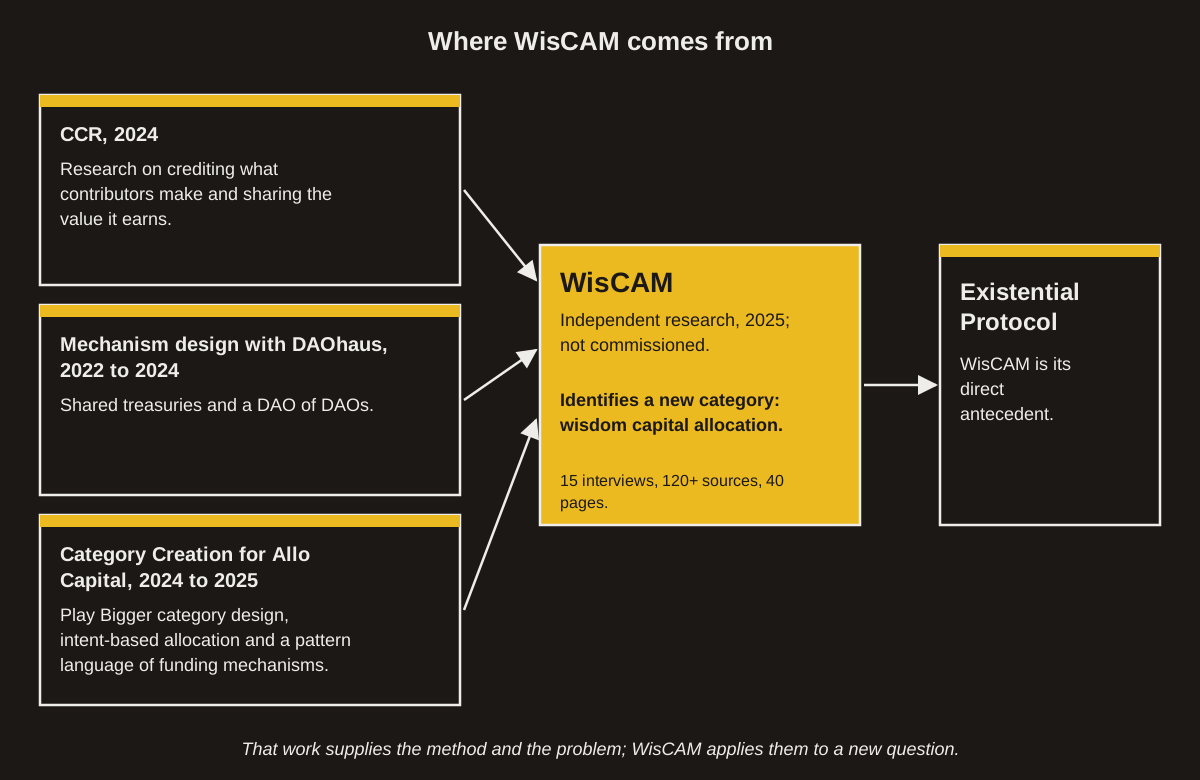
WisCAM is independent research. No client or organization commissioned it. But it draws on three strands of my work, two that came before it and one that ran alongside it, and it is the place where they meet.
- Category creation. In Category Creation, which ran alongside this research, I used the Play Bigger method of category design to define a new funding category, intent-based allocation, for Allo Capital. In WisCAM I applied the same discipline to my own question, and the report identifies a new category: wisdom capital allocation. Allo's category is about how organizations direct financial capital toward what they intend. This one is about crediting and rewarding the thinking that creates value in the first place.
- CCR. Creator Collector Reciprocity was my research on how a group could keep track of who contributed what and share the value that work earns. WisCAM asks the same question of knowledge work in general.
- Mechanism design at DAOhaus and Allo. My DAOhaus years, and the funding patterns I worked with at Allo, taught me that how capital moves between people is a design problem with patterns you can name and compare. WisCAM's mechanisms borrow that way of thinking.
My Role
I did this alone: I set the question, ran the interviews, read across the literature, and wrote the report. It was independent work, not commissioned by a client.
The Question
Knowledge work happens across many tools: chat, documents, code, forums. Good ideas get lost in threads, context has to be rebuilt again and again, and the value a person's thinking creates usually leaves no trace back to them. Existing knowledge-management tools treat this as a storage problem: better filing, better search.
My question was whether it is an economic problem instead. If insight is a kind of capital, it needs what capital has: a way to record who holds it, a way for it to grow, and a way for returns to flow back.
The Method
The project ran in three phases:
- Listening (January and February 2025). Semi-structured phenomenological interviews with fifteen knowledge workers in software, research and creative work, about how they actually experience their tools and their intellectual work. Alongside them, a literature review across phenomenology, social epistemology, commons governance and the economics of non-rival goods, and writing on coordination failure.
- Synthesis (March and April). Drawing on more than 120 sources to define what makes this kind of value different from financial capital, and why that difference calls for different mechanisms.
- Mechanism design (May to July). Specifying the mechanisms, testing them against alternatives, and writing the report.
Why This Value Needs Its Own Mechanisms
The synthesis phase came down to five properties that separate this kind of value from financial capital, and each one breaks an assumption that money's systems rely on:
| Property | What it means | Why money's tools don't fit |
|---|---|---|
| Non-rival | Sharing an insight doesn't use it up | Ownership models assume one holder at a time |
| Multiplicative | Insights combine into more than their sum | Accounting tracks units, not combinations |
| Context-dependent | The same idea is worth more in one setting than another | A single price can't capture it |
| Temporally complex | Old work can become valuable years later | Returns are usually tied to the moment of exchange |
| Network-emergent | Value arises between people, not inside one | Credit goes to individuals or not at all |
That is why the answer couldn't be a better filing system or a reputation score. It needed mechanisms built for value that behaves like this.
From What People Said to Three Mechanisms
The interviews kept surfacing three experiences, and together they shaped the framework's architecture.
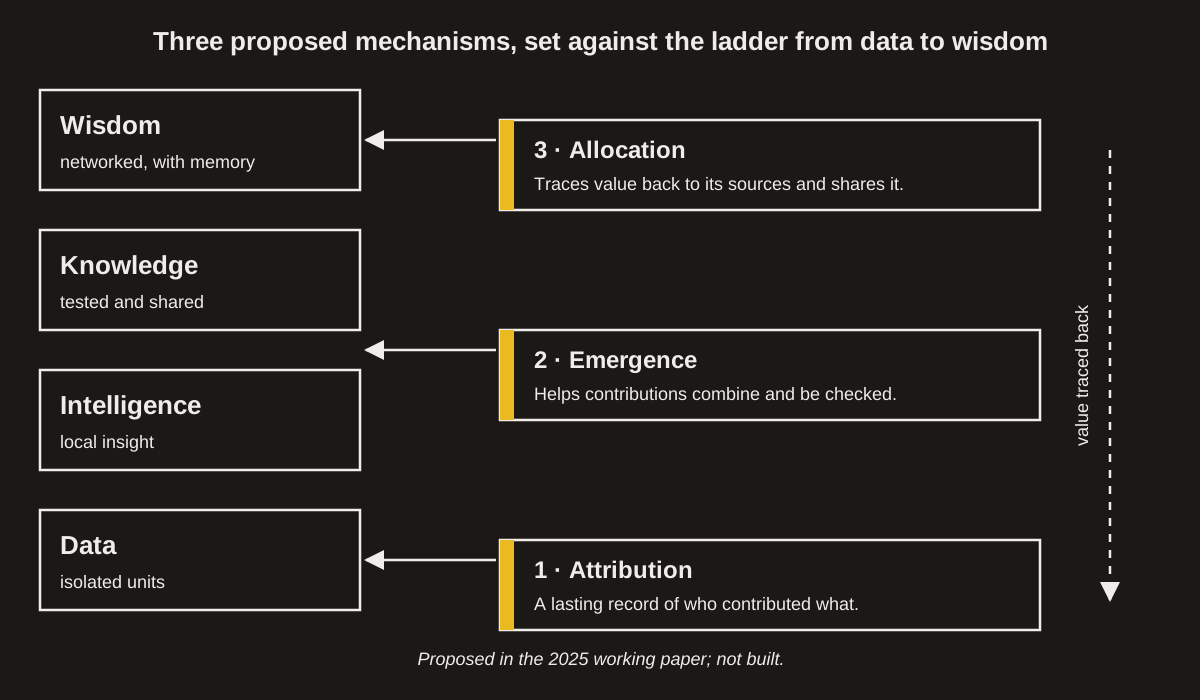
Ideas lost in threads. People described watching a good idea disappear into a chat thread, knowing they would never find it again. That made attribution the foundation: a lasting record of who contributed what, down to the level of a single insight, so the history of an idea can be traced.
Holding back half-formed thoughts. People described not sharing an idea until it felt finished, for fear someone else would take the credit. That shaped the framework's key decision: keeping attribution separate from payment. An earlier version combined them into one mechanism. Splitting them means a contribution is recorded the moment it is shared, long before anyone decides what it is worth, so an early contribution keeps its credit before anyone assesses its value.
Value nobody gets credit for. People sensed that their thinking created value for others that never came back to them. That became allocation: when a contribution leads to something valuable (a solution, a decision, a product), the value is traced back through the network of contributions it came from and shared among them, weighing recent work against the foundational work underneath it. This is where the capital-allocation patterns I had worked with at DAOhaus and Allo came in: a mechanism is something you can name, compare and configure.
Between attribution and allocation sits emergence: helping contributions combine and be checked as they move from scattered data toward shared, tested knowledge, for example by noticing when several people independently reach the same conclusion.
Alternatives I Ruled Out
A central knowledge graph. Enterprise graph platforms model relationships well, but whoever controls the platform controls the value. That reproduces the problem WisCAM set out to solve, so the design had to be decentralized despite the extra complexity.
Reputation alone. Karma, citations and on-chain reputation show recognition can work at scale. But reputation doesn't flow back or compound, and it is easy to game. WisCAM needed returns that follow actual downstream use, not prestige.
What It Led To
- The report: a 40-page working paper, which is not public. It names a new category, wisdom capital allocation, and sets out the mechanisms such a category would need.
- The Existential Protocol. The report is its direct antecedent.
What I Would Do Differently
Build something small, sooner. I stayed in theory the whole time. Even a simple prototype of attribution alone would have surfaced practical limits that should have shaped the theory.
Work in public. I researched largely alone and shared only occasional updates. Talking regularly with people who allocate capital on-chain, open-source developers and mechanism designers would have made the framework stronger.
Narrow the scope. Trying to theorize a whole economic paradigm in a single project of a few months was ambitious to the point of hubris. Going deep on one mechanism, attribution alone, would have produced more usable results than a broad but shallow framework.